A construction of the Itaipu power plant It is marked by its stages, curiosities and remarkable facts, including details about its floodgates and the importance of this binational landmark.
After all, Itaipu Hydroelectric Power Plant It is one of the largest engineering undertakings ever undertaken, marking a crucial chapter in the history of sustainable energy.
Located on the border between Brazil and Paraguay, Itaipu stands out not only for its clean energy production, but also for the grandeur of its construction.
So, continue reading and learn more about this monumental work!
How Long Did It Take to Build the Itaipu Power Plant?

Construction of the Itaipu Power Plant began in 1974 and was completed in 1984, totaling 10 years of intensive work.
Thus, during this period, around 40 thousand workers were directly involved, facing gigantic challenges that required innovative engineering and logistics solutions.
The magnitude of the project is evidenced by the volume of materials used – more than 12,7 million m³ of concrete were used – enough to build 210 stadiums the size of Maracanã.
Furthermore, the amount of iron and steel would be enough to build 380 Eiffel Towers. Just imagine?
The record for concreting in a single day was achieved on November 14, 1978, when 7.207 m³ of concrete were poured, equivalent to the construction of 24 ten-story buildings.
How was the construction of the Itaipu Hydroelectric Power Plant?
The construction of the plant was planned in complex and interdependent stages.
For example, to dam the Paraná River, it was necessary to temporarily divert the course of the river, an impressive feat accomplished in 1978.
Furthermore, the main dam, which reaches 196 meters in height (equivalent to a 65-story building), was built using different types of materials, such as concrete and rockfill, ensuring strength and stability.
In fact, the reservoir created by damming the river formed a lake with an area of 1.350 km², larger than the urban area of the city of São Paulo.
Another highlight of the construction was the planning of the Francis type turbines.
Each of them weighs around 3.360 tons and operates with a nominal flow rate of 690 m³/s, playing an essential role in the generation of electricity for Brazil and Paraguay.
Why Don't the Itaipu Dam Gates Always Open?

The floodgates at the Itaipu Power Plant are part of the spillway, a structure designed to discharge excess water that is not used to generate energy.
However, they are only opened in specific situations, such as periods of heavy rain that raise the reservoir level.
The spillway's maximum flow capacity is 62,2 thousand m³/s, equivalent to 40 times the average flow of the Iguaçu Falls.
Therefore, the floodgates do not open constantly for two main reasons:
- Preservation of Water Resources: The water stored in the reservoir is vital to ensure the continuous operation of the turbines.
- Operational efficiency: Strict control of water flow prevents waste and maximizes energy generation.
In other words, the spectacle of the open floodgates is a rare event, but one with great visual impact, attracting tourists and engineering enthusiasts from all over the world.
Interesting Facts About the Construction of the Itaipu Power Plant
At the height of the works, around 40 thousand workers participated in the project, creating a real city on the construction site.
The combined flow of the plant's two turbines is equivalent to the average flow of the Iguaçu Falls.
The volume of concrete used in the construction was greater than that used in the construction of the Panama Canal.
Ultimately, these curiosities illustrate the grandeur of the project and its global impact.
How to Visit the Itaipu Power Plant and Learn about its History?
Today, the Itaipu Power Plant is one of the most visited tourist destinations in the Triple Frontier region.
After all, Turismo Itaipu offers guided tours that explore not only the structural grandeur of the plant, but also its role in environmental preservation and regional development.
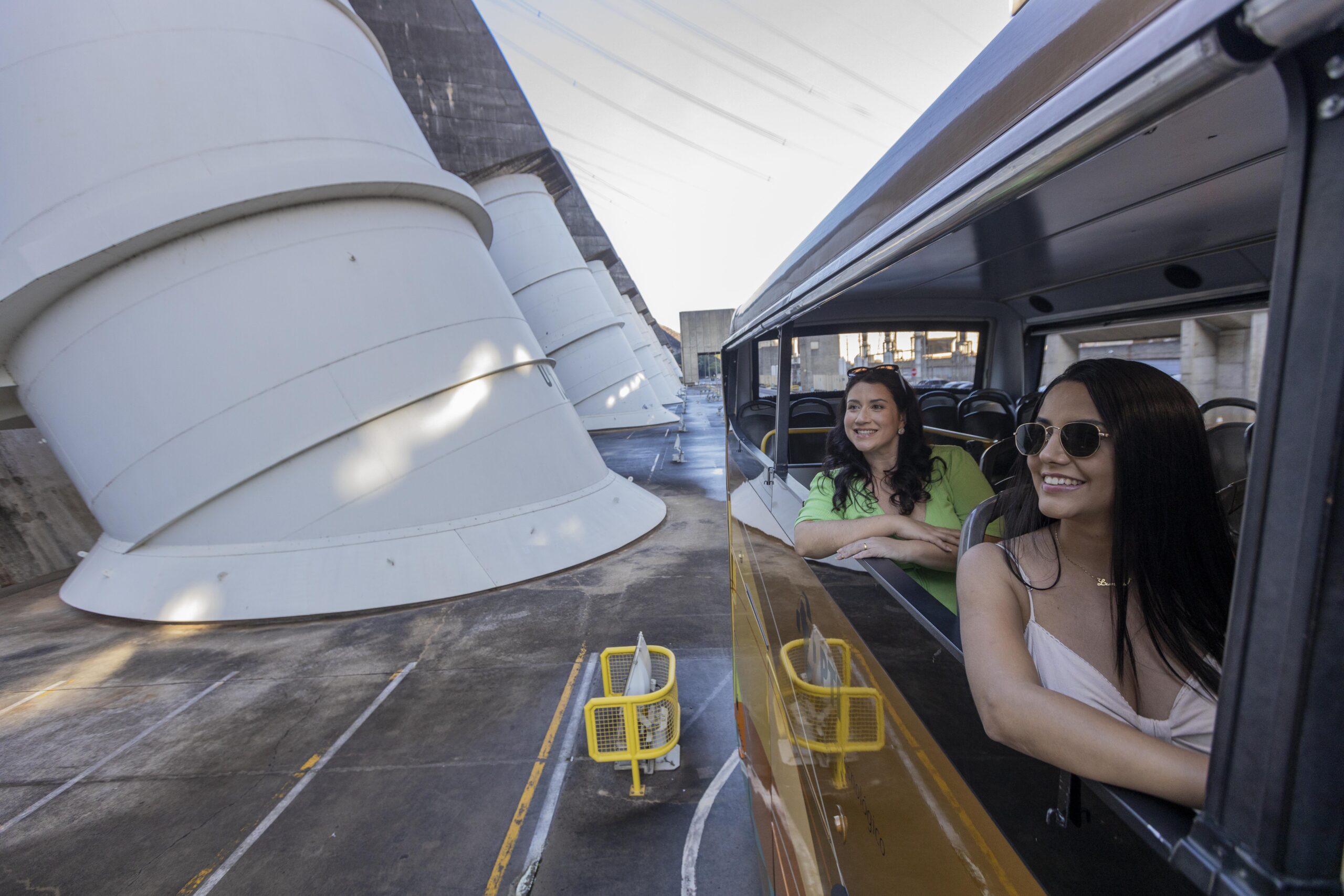
Among the attractions, the highlights are: Itaipu Special Tour, which allows visitors to see the powerhouse, turbines and even the spillway (if in operation) up close.

Why is the Construction of the Itaipu Power Plant a Milestone in Engineering?
The construction of the Itaipu Power Plant was not only a monumental work in terms of engineering, but also an example of binational cooperation between Brazil and Paraguay.
After all, it showed that it is possible to create high-tech infrastructure while respecting the environment and local communities.
Furthermore, the project contributed to technological advances in both nations and became a global reference in clean energy.
Therefore, more than a hydroelectric plant, the Itaipu Power Plant is a symbol of sustainability, innovation and international cooperation, and its construction is a milestone in the history of engineering and an example of how great challenges can be overcome with planning, technology and teamwork.
So, if you want to know more about the Itaipu Power Plant and its wonders, explore the Itaipu Tourism contents and plan your visit to this monument that combines energy, history and nature!
Images: Itaipu Tourism